Pairs trading and cointegration
A pair of nonstationary asset-price processes can have a stationary linear combination. This is cointegration (Engle-Granger 1987; Johansen 1988), and it is the theoretical foundation for pairs trading: enter when the stationary spread deviates far from its mean, exit when it mean-reverts. The demo constructs two synthetic cointegrated series, shows the spread with entry bands, and discusses why real-world pairs trading has become much harder since the 2000s.
1. Cointegration, formally
A collection of series is cointegrated of order if:
- Each series is individually , integrated of order 1, i.e., nonstationary but first-differences are stationary.
- There exists a linear combination that is , stationary.
The cointegrating coefficient is the key: if estimable, it defines a mean-reverting spread that can be traded.
2. The demo
We simulate two assets sharing a common nonstationary trend:
where is a random walk and are stationary idiosyncratic noise. The cointegrating coefficient is by construction. The spread is stationary with a well-defined mean and variance.
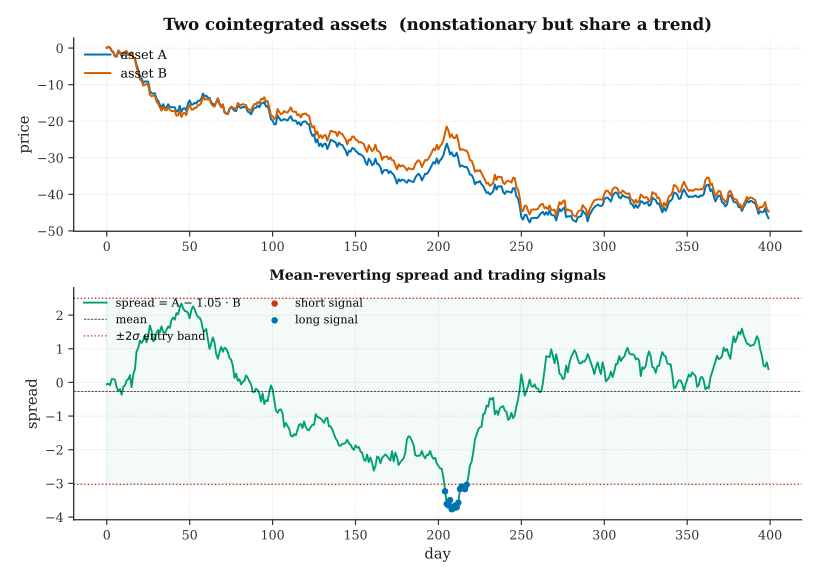
The upper panel shows the two nonstationary series; neither is stationary on its own, but they move together. The lower panel shows the spread with entry bands. Long signals (below the lower band): buy the spread (long , short ). Short signals (above the upper band): sell the spread.
3. The trading strategy
Classic pairs trading rules:
- Enter when (typically ).
- Exit when returns to or crosses the mean.
- Stop loss when or when cointegration appears to break (rolling-window cointegration test fails).
The Sharpe ratio of the strategy depends on (a) the speed of mean reversion of the spread, (b) the bid-ask and market-impact cost of the two legs, and (c) the frequency of cointegration break-ups.
4. Johansen vs. Engle-Granger
Two standard estimation frameworks.
Engle-Granger two-step. (1) Estimate by OLS: regress on . (2) Test the residual for stationarity via augmented Dickey-Fuller (ADF). If the ADF test rejects a unit root, the pair is cointegrated. Simple but sensitive to variable ordering.
Johansen test. Eigenvalue-based estimator that handles multivariate cointegration and does not require choosing a dependent variable. Preferred in practice for more than two series, and a better option even for pairs when the direction of causation is unclear.
5. Why pairs trading is harder than it looks
The empirical record since the 2000s is sobering.
Gatev, Goetzmann & Rouwenhorst (2006), the canonical empirical pairs-trading paper, find that the strategy produced annualized returns of ~11% in the 1962–2002 period. Do & Faff (2010) show the returns decayed substantially after the early 2000s. By the 2010s, simple cointegration-based pairs trading was competitive with basic risk-parity on a risk-adjusted basis.
Reasons for decay:
- Increased competition. Quantitative hedge funds arbitraged away the easiest pairs.
- Higher transaction costs on “exotic” legs. Many formerly-profitable pairs had low-liquidity components whose execution costs erased the statistical edge.
- Cointegration breakups. The statistical relationship between two securities is less stable than the method assumes. Rolling cointegration tests often reject today what was tested positive a year ago.
Modern statistical-arbitrage work has moved to higher-dimensional baskets (50–500 stocks) with factor-adjusted residuals, machine-learned signals on top of classical cointegration, and high-frequency intraday versions of the same logic.
6. References
- Engle, R. F., & Granger, C. W. J. (1987). Co-integration and error correction: representation, estimation, and testing. Econometrica, 55(2), 251–276.
- Johansen, S. (1988). Statistical analysis of cointegration vectors. Journal of Economic Dynamics and Control, 12(2-3), 231–254.
- Gatev, E., Goetzmann, W. N., & Rouwenhorst, K. G. (2006). Pairs trading: performance of a relative-value arbitrage rule. Review of Financial Studies, 19(3), 797–827.
- Do, B., & Faff, R. (2010). Does simple pairs trading still work? Financial Analysts Journal, 66(4), 83–95.
- Hamilton, J. D. (1994). Time series analysis. Princeton University Press.