Portfolio optimization and the efficient frontier
Markowitz (1952) won the Nobel Prize for a single idea: given asset return means and covariance matrix , the portfolio choice problem reduces to choosing that minimizes subject to and . The set of efficient portfolios, those that are not dominated, traces the efficient frontier in mean-variance space. The theory is elegant; the practice is humbling. We show the frontier on a 5-asset synthetic universe and discuss the central practical obstacle: parameter estimation.
1. The optimization problem
For assets with expected returns and covariance , and target return :
Lagrangian solution (unconstrained in signs, for concreteness):
with multipliers determined by the two constraints. The locus for target returns traces the efficient frontier.
2. The demo
5 assets with random return means in and a random positive-definite covariance matrix. We draw 3000 Dirichlet-random long-only portfolios and plot them in space; then we overlay the analytical efficient frontier and mark the maximum-Sharpe portfolio.
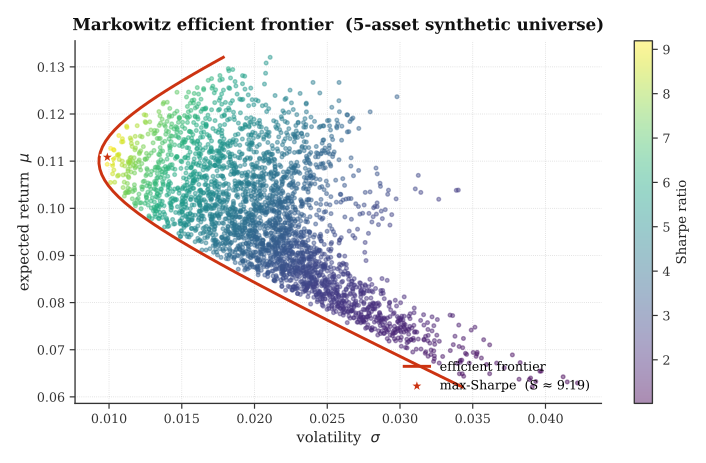
The cloud shows feasible long-only portfolios. The red curve is the efficient frontier, the upper envelope. The star marks the max-Sharpe portfolio, the tangency of a line from the risk-free rate (2% assumed) to the frontier.
3. The tangency portfolio
Tobin’s separation theorem (1958): under the simple mean-variance framework with a risk-free asset, every investor should hold a combination of (a) the risk-free asset and (b) the max-Sharpe tangency portfolio. The allocation between the two depends only on risk preference. This is a clean theoretical result and a practical starting point for portfolio construction.
4. Why Markowitz is hard in practice
The theory is clean; its failure modes in practice are substantial and well-documented.
Parameter estimation dominates. The inputs and must be estimated from historical data. Estimation error in is particularly damaging: small errors in the mean estimates produce very large differences in the implied optimal weights. Michaud (1989) called this error maximization: the optimizer is particularly attracted to assets whose mean-return estimate is upwardly biased.
Covariance singularity. When is close to the sample size (many assets, few observations), the sample covariance matrix becomes ill-conditioned. Ledoit-Wolf shrinkage (2004) and related methods provide better estimators.
Portfolio concentration. Without explicit constraints, the solution often allocates extreme positive and negative weights to a handful of assets, unstable and impractical. L1/L2 regularization, position limits, and robust-optimization formulations (Fabozzi et al. 2007) partially fix this.
Out-of-sample performance. DeMiguel, Garlappi & Uppal (2009) famously showed that in many empirical settings, a naïve equal-weighted portfolio beats mean-variance out-of-sample. The paper caused genuine reassessment of the practical value of Markowitz optimization and led to interest in risk parity and minimum-variance portfolios as simpler alternatives.
5. Modern alternatives
- Risk parity. Allocate weights so that each asset contributes equally to total portfolio risk. Reduces dependence on expected-return estimates. Bridgewater’s All-Weather fund is the canonical example.
- Black-Litterman. Combine a baseline (market-cap) prior with investor views using Bayesian updating. Produces more stable and intuitive portfolios than pure Markowitz.
- Robust optimization. Optimize over worst-case within an uncertainty set. Trades expected performance for guaranteed downside behavior.
- Hierarchical risk parity (López de Prado 2016). Use clustering to avoid inverting the covariance matrix, which reduces its ill-conditioning problems.
6. Where the optimizer breaks
Markowitz optimization is the correct abstract framework. For production portfolio construction, naive application produces unstable portfolios. Practical implementations either (a) use shrinkage/Bayesian priors, (b) use robust optimization, or (c) replace with explicit views via Black-Litterman. Pure equal-weight and risk-parity benchmarks are surprisingly hard to beat out-of-sample.
7. References
- Markowitz, H. (1952). Portfolio selection. Journal of Finance, 7(1), 77–91.
- Tobin, J. (1958). Liquidity preference as behavior towards risk. Review of Economic Studies, 25(2), 65–86.
- Michaud, R. O. (1989). The Markowitz optimization enigma: is optimized optimal? Financial Analysts Journal, 45(1), 31–42.
- Ledoit, O., & Wolf, M. (2004). Honey, I shrunk the sample covariance matrix. Journal of Portfolio Management, 30(4), 110–119.
- Black, F., & Litterman, R. (1992). Global portfolio optimization. Financial Analysts Journal, 48(5), 28–43.
- DeMiguel, V., Garlappi, L., & Uppal, R. (2009). Optimal versus naive diversification: how inefficient is the 1/N portfolio strategy? Review of Financial Studies, 22(5), 1915–1953.
- Fabozzi, F. J., Kolm, P. N., Pachamanova, D. A., & Focardi, S. M. (2007). Robust portfolio optimization and management. Wiley.
- López de Prado, M. (2016). Building diversified portfolios that outperform out of sample. Journal of Portfolio Management, 42(4), 59–69.