Multi-agent coordination and emergent behavior
A single agent optimizes its reward against a fixed environment. Multiple agents optimize against each other, and the environment they present to one another changes as they learn. We cover the classical game-theoretic baseline (Nash equilibrium and its computational complexity), the two ways that coordination can fail (social dilemmas, non-stationarity), and the mechanisms by which cooperative behavior emerges in iterated settings. The contemporary stakes are high: every LLM deployed to interact with other LLMs or with humans is a multi-agent system, and the theory of how such systems reach (or fail to reach) stable equilibria is consequential for alignment, safety, and economics.
1. The one-shot baseline
A game is a tuple : agents each with an action set and a utility .
A Nash equilibrium is a profile such that no agent can improve by unilateral deviation:
Nash’s theorem (1950) guarantees existence in mixed strategies for finite games. Existence does not imply uniqueness or efficiency, two critical failures.
1.1 The prisoner’s dilemma
The canonical example.
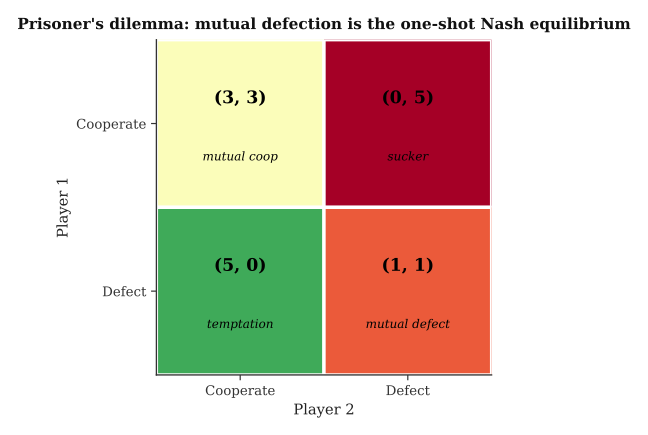
The unique Nash equilibrium is (Defect, Defect) with payoff . The socially optimal outcome is (Cooperate, Cooperate) with payoff . Every one-shot rational agent defects. The mechanism-design reading: the game is misspecified for the behavior we want.
1.2 Computational complexity
Daskalakis, Goldberg & Papadimitriou (2009) proved that computing a Nash equilibrium is PPAD-complete, in the same complexity class as Brouwer fixed points, and (if PPAD ≠ P) not solvable in polynomial time. This is a deep negative result: even for moderate-size games, finding an equilibrium is intractable by general-purpose methods.
The practical consequence: we can’t expect learning agents to converge to Nash equilibria in general. Any convergence guarantees in multi-agent learning must exploit special structure (zero-sum, potential games, convex games).
2. When coordination fails
Two distinct failure modes.
2.1 Social dilemmas
Any game where the Nash equilibrium is socially suboptimal is a social dilemma. Prisoner’s dilemma is the two-agent case; the -agent generalizations include:
- Tragedy of the commons. Each agent’s optimal use of a shared resource exceeds the socially-optimal per-agent usage.
- Public goods provision. Each agent under-contributes to a shared benefit.
- Arms races. Each agent over-invests in defensive or offensive capability because others are doing the same.
In the AI context, Dafoe et al. (2020) argue that multi-agent AI failures are more likely to come from social-dilemma dynamics than from single-agent alignment failures: each AI system optimizes its local objective, and the collective outcome is a race-to-the-bottom.
2.2 Non-stationarity and the moving-target problem
Every agent’s “environment” is the other agents’ policies. As other agents learn, each agent faces a non-stationary environment, the distribution of states and rewards shifts.
Standard RL convergence guarantees (value iteration, policy gradient) assume stationarity. In multi-agent RL, they break. Agents can chase each other’s past policies, oscillating without converging. Or they can converge to an equilibrium that is different from the Nash of the underlying game, simply because the learning dynamics are not reliable at finding the true fixed point.
Foerster et al. (2018), Learning with Opponent-Learning Awareness (LOLA), explicitly models how one’s updates will affect the other agent’s learning, sacrificing some greediness in exchange for navigating toward more cooperative outcomes. The idea generalizes: principled multi-agent learning needs to reason about the learning dynamics, not just the one-shot payoff structure.
3. How cooperation emerges
Two settings where cooperative behavior reliably arises.
3.1 Repeated games and the folk theorem
If a social dilemma is repeated indefinitely, a much wider set of outcomes becomes individually rational via trigger strategies, punishing defection with future retaliation. The folk theorem formalizes this: in an infinitely repeated game with sufficiently patient agents, any individually-rational payoff profile is sustainable as a Nash equilibrium.
Tit-for-tat (Axelrod 1984) is the famous example in iterated prisoner’s dilemma: cooperate on the first round, then copy the opponent’s previous action. It wins Axelrod’s famous tournament against all comers, despite being embarrassingly simple.
Two lessons:
- Horizon matters. Finite-horizon games unravel to one-shot Nash by backward induction. Cooperation requires the shadow of future interaction.
- Simple strategies dominate. Complex reasoning about opponent psychology is not the mechanism; reliable, legible, forgiving behavior is.
3.2 Self-play in zero-sum games
In zero-sum games (one agent’s gain is another’s loss), minimax strategies are well-defined and can be computed to convergence.
AlphaGo / AlphaZero (Silver et al. 2016, 2017) and the MuZero variant demonstrate that self-play with a learned value function can find near-optimal policies in games of enormous complexity, Go, chess, shogi. The key technical requirements are:
- Zero-sum structure (or near-zero-sum, as in chess), so minimax regret has a bounded notion of “better policy.”
- Perfect information (no hidden state), so value estimates are well-defined.
- Compute budget matching the game’s search depth.
Self-play in non-zero-sum or imperfect-information games is much harder. CFR (Counterfactual Regret Minimization; Zinkevich et al. 2007) handles imperfect information in zero-sum games and has achieved superhuman play in poker (Brown & Sandholm 2017).
4. Emergent communication and coordination
A distinct strand of multi-agent work asks whether cooperation can arise without explicit coordination mechanisms, can agents invent their own?
Foerster et al. (2016) and subsequent work show that agents with differentiable communication channels can learn to emit signals that coordinate joint action. The emergent protocols are task-dependent, often brittle, and usually lack the compositional structure of natural language. But they demonstrate that coordination signals are learnable under the right training pressure.
Lazaridou & Baroni (2020) review the emergent-communication literature. The honest summary: agents can learn to communicate, but the communication tends to overfit to the training environment and does not generalize the way human language does.
5. Cooperative MARL and its open problems
Cooperative multi-agent RL (all agents share a reward) is a more tractable setting than general-sum games. Even here, challenges persist:
Credit assignment. When the team succeeds, which agent contributed? Naive approaches (all agents get the team reward) scale poorly; more sophisticated methods (COMA, Foerster et al. 2018; QMIX, Rashid et al. 2018) use learned value decomposition.
Exploration. In large teams, uncoordinated exploration is wasteful. Methods like MAVEN and EDTI attempt to coordinate exploration explicitly.
Partial observability. Each agent sees only part of the state. Learned communication, centralized critic with decentralized execution (CTDE), and recurrent policies are the standard tools.
6. Social dilemmas with learned agents
The sharpest contemporary question: what do learned agents do in social dilemmas?
Leibo et al. (2017) and subsequent work show that simple deep-RL agents trained in sequential social dilemmas (extensions of iterated prisoner’s dilemma to spatial, temporally-extended games) reliably fail to find cooperative equilibria, even though cooperative equilibria exist. They instead settle into low-reward mutual-defection outcomes.
Jaques et al. (2019) add an intrinsic motivation for social influence (one agent’s actions causally affecting the other’s) and find that this reliably nudges agents toward cooperation.
The pattern: cooperation does not emerge by accident from standard RL. It requires either explicit mechanism design (as in note 9), reputation systems, or intrinsic motivations that reward coordination. This has direct implications for LLM agents deployed at scale: a population of LLMs, each optimizing locally, is at risk of collective failure modes that no individual agent is responsible for.
7. Open questions
Scaling multi-agent methods. Most theoretical results and empirical benchmarks involve 2–10 agents. Real systems (marketplaces, social media, LLM ecosystems) involve 1000s or more. Scaling MARL methods to this regime, without population-specific tuning, is open.
Heterogeneous agent populations. Agents with different architectures, objectives, or capabilities complicate everything. Most methods assume homogeneity; principled treatment of heterogeneous populations is early-stage.
Transfer from simulation to the world. Multi-agent methods trained in simulation often fail in deployment, where the other agents are real humans or real LLM services with their own idiosyncrasies. Sim-to-real transfer in multi-agent settings is an open empirical question.
The population-level alignment problem. If every LLM is aligned individually, is a population of LLMs aligned? Probably not, social dilemmas can emerge among locally-aligned agents. This is an underappreciated dimension of AI alignment.
8. References
- Nash, J. F. (1950). Equilibrium points in N-person games. Proceedings of the National Academy of Sciences, 36(1), 48–49.
- Daskalakis, C., Goldberg, P. W., & Papadimitriou, C. H. (2009). The complexity of computing a Nash equilibrium. SIAM Journal on Computing, 39(1), 195–259.
- Axelrod, R. (1984). The evolution of cooperation. Basic Books.
- Silver, D., Huang, A., Maddison, C. J., et al. (2016). Mastering the game of Go with deep neural networks and tree search. Nature, 529(7587), 484–489.
- Silver, D., Schrittwieser, J., Simonyan, K., et al. (2017). Mastering the game of Go without human knowledge. Nature, 550(7676), 354–359.
- Zinkevich, M., Johanson, M., Bowling, M., & Piccione, C. (2007). Regret minimization in games with incomplete information. NeurIPS.
- Brown, N., & Sandholm, T. (2017). Superhuman AI for heads-up no-limit poker: Libratus beats top professionals. Science, 359(6374), 418–424.
- Foerster, J., Assael, Y. M., de Freitas, N., & Whiteson, S. (2016). Learning to communicate with deep multi-agent reinforcement learning. NeurIPS.
- Foerster, J., Chen, R. Y., Al-Shedivat, M., Whiteson, S., Abbeel, P., & Mordatch, I. (2018). Learning with opponent-learning awareness. AAMAS.
- Rashid, T., Samvelyan, M., Schroeder, C., Farquhar, G., Foerster, J., & Whiteson, S. (2018). QMIX: monotonic value function factorisation for deep multi-agent reinforcement learning. ICML.
- Leibo, J. Z., Zambaldi, V., Lanctot, M., Marecki, J., & Graepel, T. (2017). Multi-agent reinforcement learning in sequential social dilemmas. AAMAS.
- Jaques, N., et al. (2019). Social influence as intrinsic motivation for multi-agent deep reinforcement learning. ICML.
- Dafoe, A., Hughes, E., Bachrach, Y., et al. (2020). Open problems in cooperative AI. arXiv.
- Lazaridou, A., & Baroni, M. (2020). Emergent multi-agent communication in the deep learning era. arXiv.
- Shoham, Y., & Leyton-Brown, K. (2008). Multiagent systems: algorithmic, game-theoretic, and logical foundations. Cambridge University Press.