AIXI, Solomonoff induction, and the mathematics of universal intelligence
What would optimal intelligence look like if we did not care about computability? Marcus Hutter’s AIXI (2005) gives a formal answer: an agent that uses Solomonoff induction to predict its environment’s next observation and Bellman-optimal planning to choose the action that maximizes expected future reward, averaged over all computable environments weighted by their algorithmic complexity. AIXI is provably incomputable, you cannot run it on any physical computer. But it provides a mathematical upper bound on what rational agency looks like, a reference against which practical AI can be compared, and a set of technical tools that have quietly influenced contemporary work on inductive inference, reinforcement learning, and general-purpose agents.
1. The setup
Consider an agent interacting with an environment in discrete time. At each step :
- The agent receives an observation and reward from the environment.
- The agent chooses an action .
- The environment responds with .
Let denote the history, where . Let denote the true (unknown) environment, which is a conditional distribution .
The goal is to define a policy that maximizes long-run expected reward.
2. Solomonoff induction: universal prediction
Ray Solomonoff (1964a, 1964b) proposed a universal prior over computable sequences that is, in a precise sense, the best possible prior for prediction.
2.1 The universal semimeasure
Fix a universal Turing machine . For any binary string , define the Solomonoff prior:
where is the length of program , and means on input outputs a string beginning with .
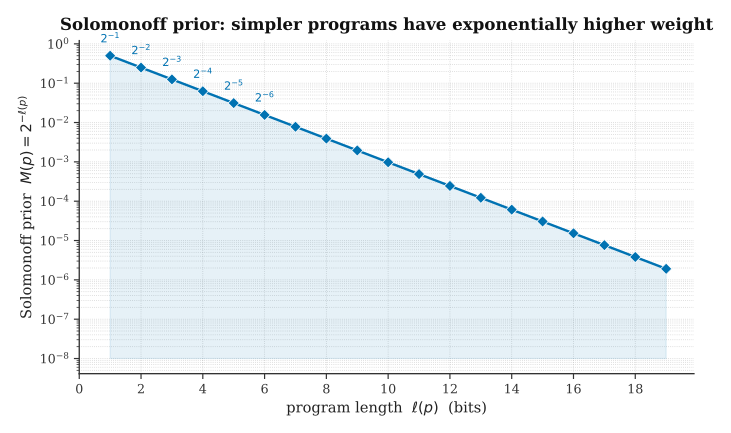
The intuition: is the probability that a random program (each bit a fair coin flip) produces as its first output. Short programs contribute more than long ones, exponentially. Simpler hypotheses get higher prior weight, a formal Occam’s razor.
2.2 The convergence theorem
Theorem (Solomonoff 1978; proofs refined by Hutter, Li & Vitányi). For any computable probability measure and any initial history, the Solomonoff posterior conditional distribution converges in total variation to :
where is the Kolmogorov complexity of (the length of the shortest program generating ‘s predictions).
In words: no matter what computable environment the agent lives in, its predictions will approach the environment’s true predictions, with total squared error bounded by a constant that depends on the environment’s complexity. Convergence rates are optimal up to constants.
This is a remarkable result. It says that a single universal predictor works optimally for any computable world. The cost is that computing requires summing over all halting programs, which is uncomputable.
3. AIXI: universal agent
Hutter (2000, 2005) combined Solomonoff prediction with Bellman-optimal planning.
3.1 The definition
AIXI’s action at step is the action that maximizes expected future reward, where expectation is taken over all computable environments weighted by Solomonoff prior:
where the outer sum is over all programs consistent with the observed history. The horizon can be finite or infinite (with discounting).
The inner sum is the Solomonoff prior; the outer maximizations implement expected-reward planning against that prior. AIXI is the combination: optimal action under optimal inference.
3.2 Properties
Incomputability. AIXI is uncomputable; not even approximable with unbounded compute in the limit. This is not a mere practical obstacle, it is a fundamental feature of the definition.
Bayes-optimality, not objective optimality. AIXI is optimal with respect to its own Solomonoff prior: by construction it maximizes expected reward averaged over the prior-weighted class of computable environments. This is Bayes-optimality relative to the prior, not a guarantee of best performance in any particular environment. Leike & Hutter (2015) showed the notion is prior-subjective, under a universal prior every policy is Pareto-optimal over the class of all computable environments, so AIXI carries no objective optimality claim; and Orseau (2010) showed AIXI need not be weakly asymptotically optimal. The Legg-Hutter (2007) intelligence measure below aggregates performance across environments under the universal prior, defining a notion of intelligence rather than proving that no other agent does better in a given world.
Self-optimizing and Pareto-optimal. In “well-behaved” environment classes, AIXI’s long-run expected reward converges to the maximum achievable.
3.3 The Legg-Hutter intelligence measure
Legg & Hutter (2007) define an intelligence functional over agents :
where is the expected cumulative reward of agent in environment , and is the Kolmogorov complexity of .
This sums an agent’s performance across all computable environments, weighted by simplicity. The measure is incomputable (of course) but provides a formal definition that makes “intelligence” a scalar function of the agent. AIXI is the argmax.
The framework is philosophically significant: intelligence is defined here without any reference to human cognition, biology, or any particular intelligence test. The definition is domain-general in a way most AI-benchmark measures are not.
4. Approximations
Since AIXI is incomputable, practical use requires approximation.
4.1 AIXI-tl
Hutter (2005) defines AIXI-tl: a time-and-space-bounded version. The agent considers only programs that terminate within steps using at most bits. AIXI-tl is computable, but the computation time is double-exponential and the approximation quality depends on .
4.2 Monte Carlo AIXI approximations
Veness et al. (2011), A Monte Carlo AIXI approximation, build a practical agent based on a context-tree weighting prior (a simpler proxy for Solomonoff) and Monte Carlo tree search (UCT) for planning. Achieves reasonable performance on simple environments (Pac-Man, small partially-observable Markov processes) but does not scale to contemporary problem domains.
4.3 Connections to modern RL
The Bayesian Reinforcement Learning literature (Ghavamzadeh et al. 2015) and model-based RL research can be viewed as AIXI-inspired, inference over possible environments combined with planning. Contemporary deep-RL world-model work (see note 15) uses learned environment models in place of the Solomonoff prior; this trades universality for computability.
5. Why AIXI matters (and where it does not)
As a gold standard. AIXI provides a yardstick against which practical agents can be compared. “Does this method converge to AIXI’s behavior in the large-compute limit?” is a well-defined question.
As a tool for impossibility results. Proofs that no computable agent can achieve property X often use AIXI as the upper bound. If AIXI cannot do X, no weaker agent can.
As a conceptual anchor. AIXI clarifies what it would mean to have a “domain-general” or “universal” agent, independent of human cognitive quirks. This is particularly useful in AGI discussions, where different parties mean different things by “AGI.”
What AIXI does not do. AIXI does not give practical algorithms. It does not tell us how to build AI that has human-compatible values, common sense, or embodiment. The gap between AIXI’s mathematical elegance and contemporary practical AI is wide and unlikely to close.
The Solomonoff prior also has deep connections to minimum description length (Rissanen 1978) and PAC-Bayes learning theory (McAllester 1999), which are practically useful descendants of the universal-prediction idea.
6. Open questions
Bounded rationality formalisms. Every practical agent is bounded in compute. How should the AIXI framework be modified for bounded rationality? Legg & Veness (2013) and subsequent work make progress; the field is not yet unified.
Embodiment and grounding. AIXI is a disembodied decision-theoretic framework. Real agents have sensors, actuators, physical constraints. Integrating these into the AIXI framework cleanly is open.
Values and preferences. AIXI maximizes a given reward function. Where the reward function comes from, from human preferences, from embedded norms, from learned values, is the alignment problem (see note 12). AIXI offers the decision theory but not the objective.
Practical approximations. Monte Carlo AIXI approximations exist but have not scaled to LLM-size problems. Whether a genuinely AIXI-like approximation is feasible at scale, or whether the formal framework must be abandoned for practical use, is an empirical question.
7. References
- Solomonoff, R. (1964a). A formal theory of inductive inference, part I. Information and Control, 7(1), 1–22.
- Solomonoff, R. (1964b). A formal theory of inductive inference, part II. Information and Control, 7(2), 224–254.
- Solomonoff, R. (1978). Complexity-based induction systems: comparisons and convergence theorems. IEEE Transactions on Information Theory, IT-24(4), 422–432.
- Hutter, M. (2000). A theory of universal artificial intelligence based on algorithmic complexity. arXiv.
- Hutter, M. (2005). Universal artificial intelligence: sequential decisions based on algorithmic probability. Springer. [The canonical AIXI book.]
- Legg, S., & Hutter, M. (2007). Universal intelligence: a definition of machine intelligence. Minds and Machines, 17(4), 391–444.
- Li, M., & Vitányi, P. M. B. (2008). An introduction to Kolmogorov complexity and its applications. Springer. [The standard reference for algorithmic information theory.]
- Veness, J., Ng, K. S., Hutter, M., Uther, W., & Silver, D. (2011). A Monte Carlo AIXI approximation. Journal of Artificial Intelligence Research, 40, 95–142.
- Ghavamzadeh, M., Mannor, S., Pineau, J., & Tamar, A. (2015). Bayesian reinforcement learning: a survey. Foundations and Trends in Machine Learning.
- Rissanen, J. (1978). Modeling by shortest data description. Automatica, 14(5), 465–471.
- McAllester, D. (1999). PAC-Bayesian model averaging. COLT.